How Many Moving Boxes Do You Need?
Typical box counts from movers for a studio to a 3 bedroom home, how to adjust them for your own things, and which box sizes to use.


In this guide
The short answer
- Studio: about 15 to 30 boxes
- 1 bedroom: about 18 to 30 boxes
- 2 bedroom apartment: about 27 to 46 boxes
- 3 bedroom house: anywhere from 70 to 150 boxes
These are movers' published numbers: a starting point, not a target. Your own count depends on how long you have lived in the home, how many people live there, and how many books, dishes and clothes you have. Start with the range for your home size, then adjust it room by room as you sort.
Typical Box Counts by Home Size
These are typical ranges from movers' own guides. Where a source lists dish packs and wardrobe boxes, they are included in the count.
| Home size | Typical range | From |
|---|---|---|
| Studio | 15 to 30 boxes | MiniMoves 15 to 19; Two Men and a Truck 16; Moving Help 16 to 29 |
| 1 bedroom | 18 to 30 boxes | MiniMoves 18 to 22; Two Men and a Truck 30 |
| 2 bedroom apartment | 27 to 46 boxes | MiniMoves 27 to 37; Two Men and a Truck 46 |
| 3 bedroom apartment | 39 to 53 boxes | MiniMoves |
| 2 bedroom house | about 76 boxes | Two Men and a Truck |
| 3 bedroom house | 70 to 150 boxes | United Van Lines 70 to 150; Two Men and a Truck 91 (3 or more bedrooms with a den) |
Houses usually need more boxes than apartments with the same number of bedrooms, often because of garages, basements and extra storage.
Why the ranges are wide: a two-bedroom apartment lived in for a year and a two-bedroom house lived in for twenty are different moves.
Allied Van Lines' packing calculator asks exactly these questions: how many years you have lived in the home, whether closets and cabinets are full, and whether things are kept in an attic or a storage unit.
How to Find Your Own Number
- Start with your home size. Pick the row above that matches your home and take the middle of the range.
- Move up or down for how you live. Full closets, a garage or attic, collections, or many years in one place push you toward the top. A recent move, a lighter style or a home you have already sorted puts you near the bottom.
- Check it against the people. From our own moving experience, each person's clothes, shoes and bedding fill about 10 to 15 medium boxes. Use this as a check, not an extra: it is already inside the ranges above.
- Sort before you count. Decide what is not coming with you first. Every item you sell, donate or leave behind is one less thing to pack.
- Check the heavy and fragile things separately. Books, dishes and hanging clothes each have their own box type (see the next table), and they change the count more than anything else.
- Buy most of your list, then top up. It is easier to pick up a few more boxes halfway through than to guess perfectly on day one.
Which Box for Which Things
We lean on small and medium boxes. Large boxes get heavy quickly, so keep them for light, bulky things such as pillows and bedding. These are rules of thumb from moving experience, not exact capacities.
| Box | Good for | Rule of thumb |
|---|---|---|
| Small | Books, files, pantry jars, toiletries, tools | About 12 to 15 hardcover books |
| Medium | Folded clothes, shoes, kitchen tools, toys, linens | Most of your boxes |
| Large | Pillows, bedding, lampshades | Light things only |
| Dish pack | Plates, bowls, glasses, vases | Sturdier walls for breakables |
| Wardrobe | Hanging clothes, kept on hangers | One box for every 1.5 feet of hanging clothes |
What you'll need besides boxes
- About one roll of packing tape for every 10 boxes
- Packing paper for dishes and glass
- A marker: label each box with its room and a few words about what is inside
Questions People Ask
How Many Wardrobe Boxes Do I Need?
Measure your hanging clothes along the rail. A regular closet holds about 4 feet of clothes, and one wardrobe box takes about 1.5 feet without squeezing, so a regular closet usually needs 2 to 3 wardrobe boxes. A walk-in closet needs more.
Do Movers Bring Boxes?
Most movers bring blankets, tape and wrap to protect furniture, and many sell boxes as well. Whether wardrobe boxes are included varies by company, so ask yours what comes with the move.
What If I End Up With Extra Boxes?
That is a good problem. Flat, unused boxes store easily for your next project, and a neighbor or friend who is moving will usually be glad to have them.
How Barreleyes Makes This Faster
Barreleyes helps you keep track of what you own, room by room, and the box list is part of it.
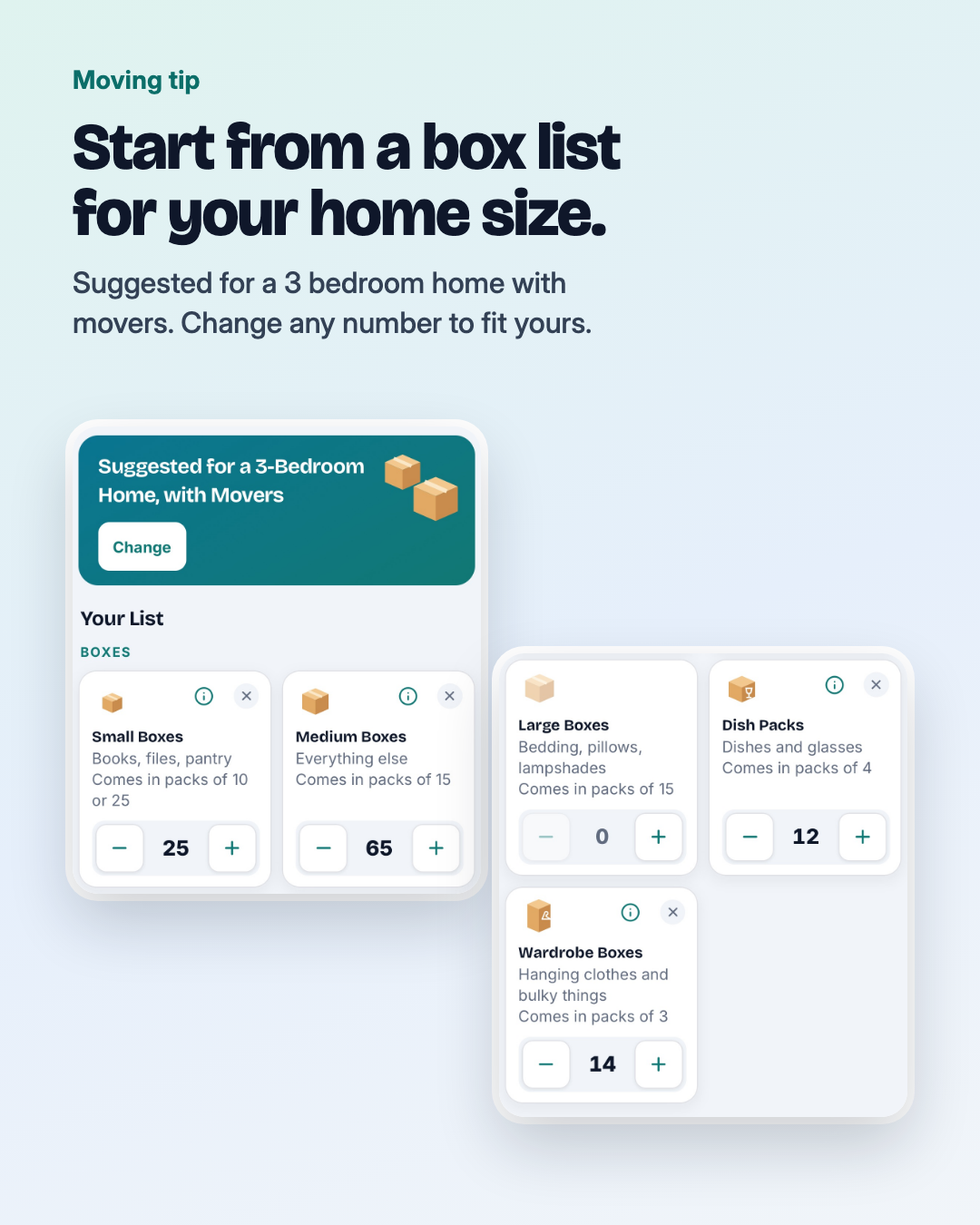
- A starting box list you can change. Packing Supplies asks how many bedrooms you have and who is moving you, and offers a starting kit of boxes and supplies for a home that size, based on moving experience. It does not count your boxes for you, because only you know what is in your cupboards. Change any number to fit your home.
- Your rooms as a list. A few photos or a short video of a room give you a list of what is in it, each item with its photo and size. Check it and fix anything it missed or got wrong.
- Only what is coming. Mark each item Moving, Storage, Donate, Sell or Dispose, so the list matches the move you are making.
- Send it to movers you choose. Share the list by email, text or a link. They see each item with its photo and size, the same list you do.
Sources
- MiniMoves, How Many Boxes Do You Need To Move Out of An Apartment?
- Two Men and a Truck, How Many Moving Boxes Are Needed for Your Move?, A Very Moving Blog, 20 August 2014.
- United Van Lines, The Recommended Moving Supplies List From America's #1 Mover, 13 May 2020.
- Moving Help, Apartment Moving Guide: Studio, 22 August 2023.
- Allied Van Lines, Packing Calculator.
- Box contents, wardrobe box and tape rules of thumb: Barreleyes, from our own moving experience.